Korean Companies Setting Up Singapore Subsidiaries
- - -
- 6일 전
- 5분 분량
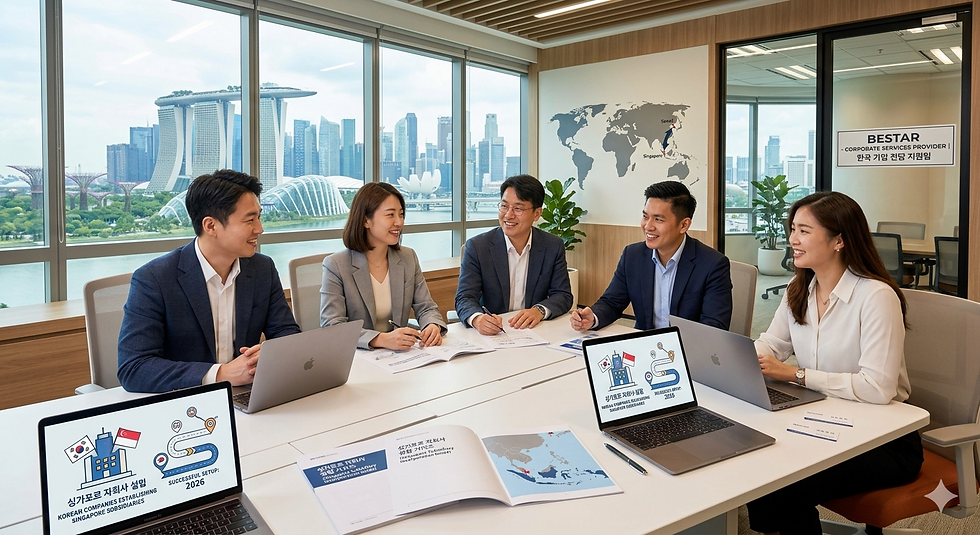
Korean Companies Setting Up Singapore Subsidiaries
Building a presence in Singapore is a strategic milestone for Korean enterprises looking to scale across Southeast Asia. In 2026, the process remains streamlined, yet new regulatory updates—particularly regarding AI tax incentives and enhanced transparency—require careful navigation.
This guide outlines the essential steps for Korean companies to successfully establish a Singapore subsidiary.
1. Why a Subsidiary is the Best Choice for Korean MNCs
While branches and representative offices are options, the subsidiary is the most popular structure for Korean companies (e.g., Samsung, Hyundai, and promising K-startups).
Separate Legal Identity: The parent company in Seoul is protected from the liabilities of the Singapore entity.
Tax Residency: Unlike a branch, a subsidiary is considered a Singapore tax resident, making it eligible for local tax exemptions and the extensive Korea-Singapore Double Taxation Avoidance Agreement (DTAA).
100% Foreign Ownership: Korean entities can own 100% of the shares with no requirement for local partners.
2. Pre-Registration Checklist (2026 Requirements)
Before filing with the Accounting and Corporate Regulatory Authority (ACRA), ensure you have the following:
Requirement | Details |
Company Name | Must be approved by ACRA; avoid names identical to existing entities. |
Paid-up Capital | Minimum S$1. However, S$1,000–S$50,000 is recommended for bank account approvals. |
Resident Director | At least one director must be "ordinarily resident" (Singapore Citizen, PR, or EntrePass/EP holder). |
Company Secretary | Must appoint a qualified local secretary within 6 months. |
Registered Office | A physical Singapore address (cannot be a P.O. Box). |
3. Step-by-Step Incorporation Process
The entire process is digitalized via ACRA’s BizFile+ portal. Since foreign entities cannot access this directly without a SingPass, you must engage a registered filing agent.
Step 1: Name Reservation
Your agent submits the proposed name. Approval usually takes minutes unless the name contains restricted words (e.g., "Bank," "Finance," or "University").
Step 2: Documentation for Korean Parent Company
You will need notarized and translated (English) copies of:
Certificate of Incorporation of the Korean parent.
Extract of the Korean Registry of Companies.
Board Resolution authorizing the setup of the Singapore subsidiary.
Passport and proof of residence for appointed directors.
Step 3: Registration & RORC Filing (New for 2026)
Upon submission, ACRA typically approves the company within 1–3 business days.
Important 2026 Update: The Register of Registrable Controllers (RORC) must now be filed on day one of incorporation to ensure transparency of beneficial ownership.
4. Post-Incorporation: Banking and Tax
The "Bank Account Bottleneck"
In 2026, opening a corporate bank account remains the most time-consuming step (2–6 weeks). Digital banks like Aspire or Airwallex offer faster onboarding for K-startups, while traditional banks (DBS, UOB) provide more robust trade financing for larger MNCs.
2026 Tax Incentives for Korean Companies
Corporate Income Tax (CIT) Rebate: For the Year of Assessment 2026, companies receive a 50% rebate on tax payable (capped at S$40,000).
Enterprise Innovation Scheme (EIS): Korean tech firms can claim 400% tax deductions on qualifying AI expenditures (up to S$50,000).
DTAA Benefits: Under the Korea-Singapore treaty, withholding tax on dividends is often reduced to 10% or 15%, and 0% on certain interest payments.
5. Frequently Asked Questions
Q: Can a Korean citizen be the sole director of a Singapore subsidiary?
A: No. At least one director must be a Singapore resident. Many Korean companies use a Nominee Director service initially while they apply for an Employment Pass (EP) for their Korean executive.
Q: How long does it take to set up?
A: Incorporation takes 1–3 days, but full operational readiness (including bank accounts and GST registration) typically takes 4–8 weeks.
Q: What is the corporate tax rate in Singapore?
A: A flat 17%. However, with partial tax exemptions for new start-ups, the effective rate for the first S$200,000 of income is often much lower (approx. 8–9%).
Ready to Expand to Singapore?
Setting up a subsidiary is the first step toward regional dominance. By leveraging Singapore’s 2026 AI incentives and stable regulatory environment, Korean companies can build a resilient bridge between Seoul and the global market.
Contact a registered corporate service provider today to begin your ACRA filing.
Bestar Registered Corporate Service Provider
Choosing a registered corporate service provider (CSP) is the single most important decision for founders looking to navigate Singapore’s strict regulatory landscape. In 2026, compliance isn't just about filing forms—it’s about leveraging technology to stay ahead of ACRA and IRAS mandates.
Bestar has established itself as a leading multidisciplinary firm, bridging the gap between traditional corporate secretarial services and high-tech financial advisory.
Why Choose Bestar as Your Corporate Service Provider?
Bestar stands out for its one-stop-shop model. Unlike digital-only platforms that lack personalized advisory or large-tier firms that are cost-prohibitive for SMEs, Bestar provides a "Goldilocks" solution: robust enough for MNCs, yet accessible for startups.
1. 2026 Technology: The "SMART Audit" & AI Integration
In 2026, Bestar has integrated AI-driven automation into its core services.
100% Data Testing: Utilizing "SMART Audit" technology, Bestar moves beyond manual sampling to test entire datasets, ensuring superior oversight for statutory audits.
Automated Compliance: Their digital dashboard tracks the latest ACRA penalties (which can reach S$5,000 for non-compliance) and provides real-time alerts for filing deadlines.
2. Comprehensive Service Spectrum
Bestar operates through specialized entities—Bestar Consulting, Bestar Services, and Bestar Assurance PAC—allowing us to handle everything from basic bookkeeping to complex M&A due diligence.
Service Category | What Bestar Offers |
Incorporation | Full setup (S$650 inclusive of ACRA fees) with rapid 1–3 day approval. |
Corporate Secretarial | Resident secretary appointment, AGM management, and RORC maintenance. |
Accounting & Tax | Cloud bookkeeping (Xero/QuickBooks), GST filing, and 2026 CIT Rebate optimization. |
Foreigner Support | Nominee Director services and Employment Pass (EP) applications (COMPASS-aligned). |
Bestar Pricing & Packages (2026)
Bestar is known for transparent, fixed-fee structures that prevent "bill shock" at the end of the financial year.
Startup Launch Package (S$650): Includes ACRA registration fees (S$315), 12 months of secretarial services, and the preparation of the company constitution.
Nominee Director Services (S$2,500/year): A critical requirement for foreign founders, often bundled with secretarial services for regulatory consistency.
Registered Office Address (S$180/year): A physical address in Singapore to meet statutory requirements.
Strategic Advantage for Mid-Market & Global Firms
While many CSPs focus only on Singapore, Bestar offers a regional footprint covering Malaysia, Hong Kong, South Korea, and the UAE.
Expert Insight: For Korean or Middle Eastern companies setting up in Singapore, Bestar acts as a cross-border liaison, managing the Korea-Singapore Double Taxation Agreement (DTAA) and ensuring that tax residency certificates are filed correctly to minimize withholding taxes.
Key Differentiators:
M&A Specialization: Through Gold House M&A, we assist businesses in valuation and exit strategies.
Accredited Professionals: Led by Chartered Accountants and Financial Forensic Professionals.
Proactive Advisory: We don’t just record your numbers; we provide insights into the 2026 Enterprise Innovation Scheme, helping you claim 400% tax deductions on AI expenditures.
Frequently Asked Questions
Is Bestar a registered filing agent?
Yes. Bestar is a licensed Corporate Service Provider (CSP) under the ACRA Act, ensuring full compliance with the enhanced 2025/2026 AML (Anti-Money Laundering) requirements.
Can Bestar help with bank account opening in 2026?
Absolutely. We have streamlined onboarding processes with traditional banks like DBS/UOB and digital-first providers like Aspire, which is often the fastest route for new entities.
Does Bestar handle GST registration? Yes. We manage both mandatory and voluntary GST registration, which is essential for companies wanting to claim input tax credits on high initial setup costs.
Conclusion: Secure Your Business Future
Whether you are a solo entrepreneur or a regional group, Bestar provides the stability of a veteran firm with the agility of a modern tech partner.
Ready to scale? Contact Bestar today for a customized compliance roadmap.
댓글